
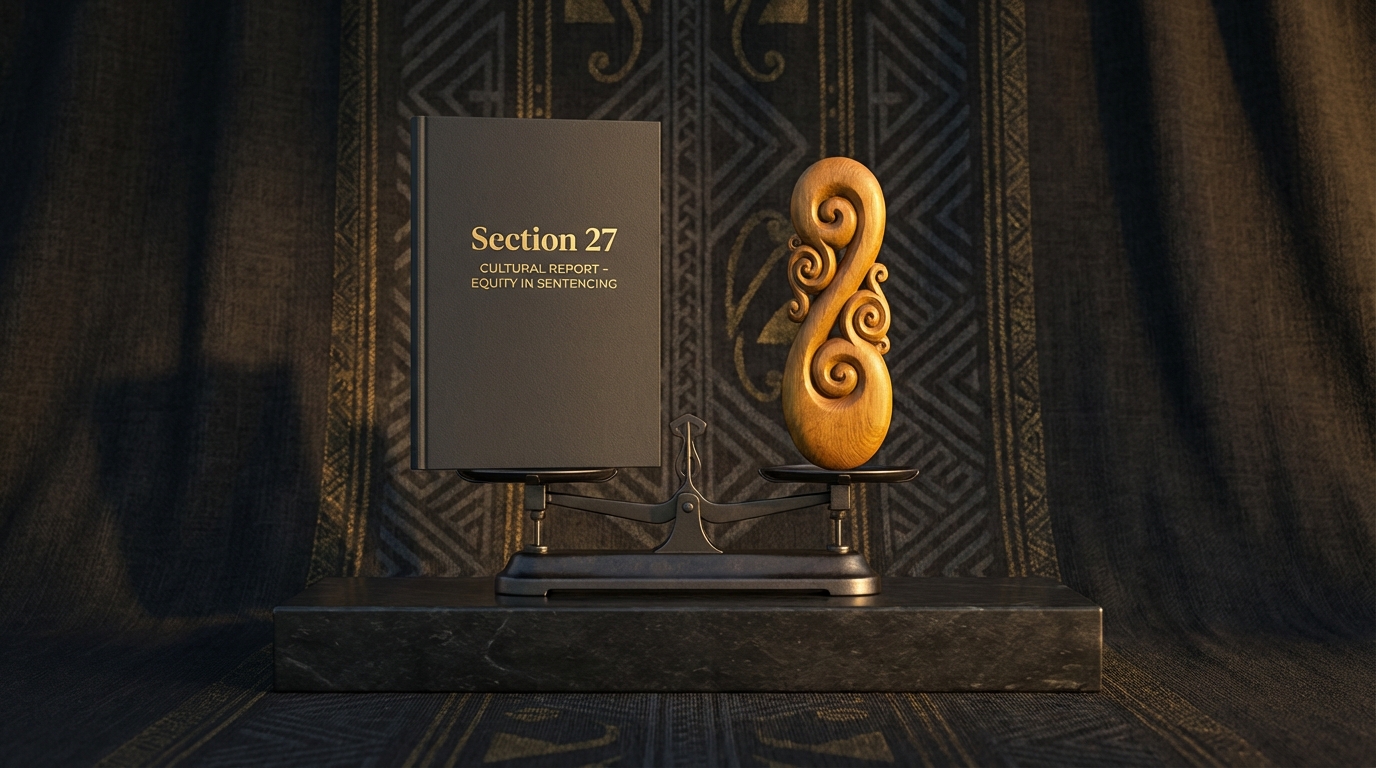
A Section 27 report — usually called a cultural report — is a specialist document the court may receive under s 27 of the Sentencing Act 2002. It gives the judge a properly evidenced picture of an offender's personal, family, whānau, community and cultural background, and how those factors connect to the offending and to realistic rehabilitation pathways. This guide explains what the cultural investigation involves, who can request one, and how New Zealand courts use the report at sentencing.
Key Takeaways
- A Section 27 report is a cultural report received under s 27 of the Sentencing Act 2002
- The cultural investigation covers personal, family, whānau, community and cultural factors
- The court can direct a report, and offenders or counsel can seek one before sentencing
- Reports inform culpability assessment under s 8 and mitigation under s 9
- Well-evidenced reports can support sentence discounts and rehabilitative outcomes
What Is a Section 27 Report?
Section 27 of the Sentencing Act 2002 creates a formal pathway for the court to receive information about an offender's background that would otherwise never reach the judge. The provision allows the offender to request that the court hear persons who can speak to the offender's personal, family, whānau, community and cultural background, and to how that background may have related to the commission of the offence.
Unlike the statutory pre-sentence report prepared by Ara Poutama Aotearoa (the Department of Corrections), a Section 27 cultural report is an independent, strengths-based investigation. It is prepared by specialists with cultural competence, and it focuses on the lived circumstances that shaped the offender — not only the offending itself.
"If an offender appears before a court for sentencing, the offender may request the court to hear any person or persons called by the offender to speak on— (a) the personal, family, whanau, community, and cultural background of the offender; and (b) the way in which that background may have related to the commission of the offence."
What a Cultural Investigation Covers
A quality cultural investigation is structured around the five background areas named in the Act, and draws on interviews with the offender and their whānau, records review and community consultation:
📌 Personal History
Childhood circumstances, education, employment, health and any experiences of trauma, abuse, or dislocation that bear on the offending and on rehabilitative needs.
📌 Whānau & Whakapapa
Family structure, whakapapa connections and intergenerational factors — including the effects of colonisation, urban displacement and systemic disadvantage where relevant.
📌 Cultural Identity
The offender's cultural identity, connection to te ao Māori or other cultures, and how identity loss or reconnection affects accountability and rehabilitation.
Community Connections
The investigation identifies community ties, marae or church involvement, and support networks that can sustain a rehabilitative sentence — practical information the court needs when considering community-based outcomes.
Linking Background to Offending
Crucially, the report does not simply catalogue disadvantage. It explains how background factors contributed to the offending, and what interventions address those causes rather than symptoms.
Protective Factors & Pathways
Strengths-based findings — stable whānau support, cultural reconnection plans, treatment engagement — give the court concrete conditions and programmes to attach to a sentence.
Standards & Independence
Independent reports prepared by culturally competent specialists carry weight because they are evidence-based, balanced and written for judicial use rather than advocacy.
Who Can Request a Section 27 Report?
Either the court or the parties can initiate the process. The court may direct that a report be prepared, and the offender or their legal counsel can seek one before sentencing. In practice, defence counsel increasingly commission reports early so the findings are ready when the judge sentences.
Referral & Scoping
Counsel or the court identifies the sentencing issues the report should address, including any AOD, cultural identity or whānau factors.
Investigation
The writer interviews the offender and whānau, reviews records and consults community sources — typically over two to four weeks.
Funding
Section 27 reports do not qualify for legal aid funding; they are privately instructed or court-directed. Funding arrangements have changed in recent years — see our guide to cultural report funding changes.
Court Use
The completed report is filed for sentencing, where counsel rely on its findings in mitigation and in proposing rehabilitative sentences.
How Courts Use Section 27 Reports
Cultural reports do two jobs at sentencing. First, they inform the court's assessment of culpability under s 8 of the Sentencing Act 2002, by contextualising the offending within the offender's actual circumstances. Second, they supply the evidence base for mitigating factors under s 9 — including the offender's personal, family, whānau, community and cultural background.
"...must take into account the offender's personal, family, whanau, community, and cultural background in imposing a sentence or other means of dealing with the offender with a partly or wholly rehabilitative purpose."
Recent appellate guidance requires that any discount claimed on cultural grounds be properly evidenced. That has made independent, well-documented cultural reports more important than ever: a report that clearly links background factors to offending and to realistic rehabilitation supports both fairer sentencing and sentence equality across defendants with similar circumstances.
Section 27 Reports and AOD Assessments
Where alcohol or other drug use contributed to the offending, courts expect evidence about both cultural background and substance use. A cultural report and an independent cultural report service work best alongside a specialist AOD assessment, so the judge sees how addiction, background and recovery intersect.
When Both Reports Are Commissioned
- Combined Causation: The court sees how cultural dislocation and substance use interacted to drive the offending
- Coherent Recommendations: Culturally-grounded rehabilitation plans align with clinical AOD treatment pathways
- Stronger Mitigation: Each report evidences different s 9 factors, reducing gaps in the mitigation picture
Case Example: Cultural Investigation in Practice
In a recent sentencing matter, a defendant facing a custodial starting point commissioned a Section 27 report alongside an independent AOD assessment. The cultural investigation documented intergenerational dislocation from his iwi, the loss of te reo and cultural identity across two generations, and the role that disconnection played in his alcohol dependence.
The report paired those findings with a concrete plan: reconnection through his marae, whānau supervision, and an AOD programme with cultural support. With both reports before the court, counsel successfully argued for a community-based sentence with intensive rehabilitation conditions — an outcome neither report could have achieved alone.
Need a Section 27 Cultural Report?
Our specialists prepare independent, court-accepted cultural reports across New Zealand — often alongside AOD assessments for a complete sentencing picture.